



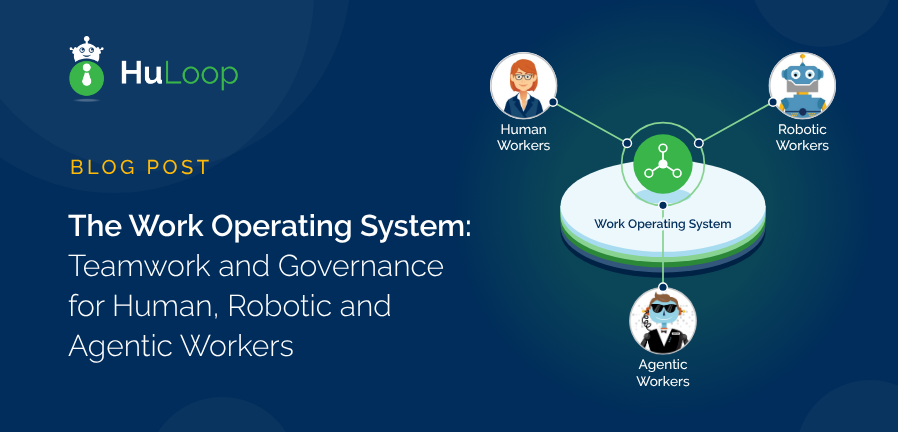
The Work Operating System: Teamwork and Governance for Human, Robotic and Agentic Workers
SHARE THIS:
A predictive guide for executives at community banks and credit unions
By Todd P. Michaud, President and CEO, HuLoop Automation
Community banks and credit unions do not usually like to be lumped together, and they have good reasons. Their charters, ownership structures and relationships with the people they serve are different. On this subject, though, the two face exactly the same challenge. Digital workers are about to arrive in both, from the same directions, into the same kinds of legacy environments, with the same small teams left to manage them. So this post speaks to both at once.
Within two years, a meaningful share of the work inside your community-based financial institution will be done by workers who never appear on an org chart. They will not need a desk, a badge or a benefits package, but they will log in to your systems, read your documents, make recommendations and, in many cases, take action. Some will be Robotic Workers that follow fixed rules at high speed. Others will be Agentic Workers that pursue a goal, plan the steps and adapt along the way. Working beside your Human Workers, they will change how much work a small institution can absorb without adding headcount.
That is good news for institutions that struggle to hire and lose too much staff time to repetitive tasks. It also creates a management problem that most leadership teams and boards have not yet seen. Digital workers will not arrive as one program with one owner. They will arrive from several directions at once, each one touching member and customer data and money, and each one built a little differently from the last. The institutions that benefit most will be the ones that decide, before the wave arrives, how every worker, human or digital, will be managed.
For community-based financial institutions, embracing this future is not optional. If you do not, national and regional financial institutions will seize the advantage. They have never been afraid to throw money, people and technology at a problem, and many are now willing to remake their business models to be tech-enabled, almost software company like. Every month they spend building a digital workforce widens the gap in cost, speed and the experience they give members and customers.
Community-based financial institutions can win this race, because they hold advantages the larger players struggle to match. They move faster, they are more agile, and they are willing to select pre-made technology solutions designed for their businesses instead of building everything themselves. That last point matters most. You should not assume you can compete with larger enterprises for top AI expertise. Bringing new talent into your institution should be one of your strategies, but most institutions will not be able to win and keep that expertise over the long term. AI talent is scarce, and the competition for it has become a bidding war. The winning approach pairs your speed and agility with proven solutions built for institutions like yours.
This post is my prediction of how that wave will reach community-based financial institutions, what will go wrong if it is left unmanaged, and the simple operating model that keeps people and digital workers working as one team.
Where community-based financial institutions start today
Any prediction has to begin with the reality on the ground. Most community-based financial institutions, including community banks and credit unions, run on core systems that were built decades ago, before AI or even the internet. Those cores have served their institutions faithfully for many years. They were made to record transactions reliably, and they do that job well, but they are slow to change and were never designed to learn, plan or act on their own. Replacing a core is a long, costly project with modest return, and most institutions cannot afford to wait for one before they move.
Around the core, institutions have assembled a collection of best of breed solutions for lending, digital banking, cards, fraud, onboarding and compliance. Many of these come from fintechs that do things the core could not do on its own. The result works, but it is a patchwork. Each solution has its own screens, its own data and its own way of doing things, and a great deal of daily work happens in the gaps between them, where people copy, re-key, reconcile and chase.
Behind all of this sits a small, stretched IT team. Community-based financial institutions do not have large technology staffs, and the people they do have spend most of their time patching, fixing and maintaining what already exists rather than deploying anything new. They are asked to keep the lights on, answer security questionnaires, support vendor upgrades and respond to the next urgent request, and there is rarely time left to innovate.
That is the environment digital workers are about to enter. Any model for managing them has to work with the systems institutions already have, without a core replacement, and it has to be something a business leader can run without a team of AI engineers. A governance approach that depends on a large internal technology bench will not survive contact with the way community-based financial institutions actually operate.
Three onramps, one workforce
Digital workers will merge onto your institution’s highway from three onramps, and over the next two years most institutions will find all three carrying traffic, whether they planned it or not. They are not equally wise to build.
Whatever the onramp, they all merge onto the same road. Human, robotic and agentic workers are three types of workers, but they are one workforce. Most institutions are not thinking about it that way. They manage people through HR, robots through IT or operations, and agents wherever a vendor happened to put them, which is how a workforce ends up with three sets of rules and nobody in charge of the whole.
Some of those workers will be invited. Someone will make a business case, name an owner and decide to bring them in. Others will not be officially welcomed before they show up. They will appear in a vendor release, on an employee’s personal account, or inside a tool someone connected to save an afternoon. Both kinds will be working in your environment, and the ones nobody invited are the ones nobody is managing.
The first onramp is home grown. Your own people, closest to the work, will build digital workers with the tools already on their desks. An operations analyst will wire up a script to move data between two systems. A lending assistant will build an AI helper in a spreadsheet or a Copilot tool. These efforts start with good intentions and real time savings. Still, for most community-based financial institutions, letting your people build their own agents is not a good idea. Building an agent safely takes a level of IT understanding, along with awareness of security, privacy, AI model governance and even budget controls and guardrails, that business users do not have and should not be expected to have. Most community-based financial institutions cannot afford shadow IT. They need solutions that are fully tested and resilient, and home grown builds usually begin with no policy, no review and no record of what data goes in. Choosing an AI model should not be left to end users either, because that choice affects accuracy, cost, data exposure and what an examiner will ask you to explain. Your people’s knowledge of the work is the most valuable input to any digital worker, and it should flow into a governed environment rather than into one-off builds.
The second onramp is folded in by your existing vendors. Your core, digital banking, card, lending and fraud providers are all adding agents to products you already run. Many will switch on automatically in a release, with a new line in the release notes and a new set of actions taken inside your environment. You did not hire these workers, but they will act on your members’ and customers’ behalf all the same.
The third onramp is purchased as best of breed. As the value of digital workers becomes clear, institutions will buy specialized agents for fraud, collections, onboarding, document processing and compliance, each from a vendor that is the leader in its niche.
The second and third onramps can be sound choices when the workers they bring in are governed like everyone else. The first onramp calls for the most caution, and for most institutions it should stay closed to unmanaged building. The trouble in every case is what happens when all three are carrying traffic at once and nobody is directing it.
Why proliferation makes a messy situation messier
Community-based financial institutions already live with fragmented work. By our own measure, two thirds of processes are fragmented, outdated or ignored, half of all work happens outside enterprise software, and a third of employee capacity goes to repetitive, low-value tasks. Adding digital workers from three directions without a common management model does not fix that picture. It makes it more fragmented and more bespoke. Proliferation is not progress by itself. It means more mess than you have today, a Frankenstein workforce stitched together from parts that were never designed to work together, with nobody responsible for how the whole creature behaves.
Every home grown script becomes a one-off that only its author understands. Every vendor agent arrives with its own settings, its own logging and its own idea of when to ask for help. Every best of breed purchase brings another console, another set of credentials and another contract to track. After a year, no one can answer simple questions. How many digital workers are acting in our environment today? What can each one see and change? Who is accountable when one makes a mistake? What happens to the member’s or customer’s request when it stops?
Those questions are exactly the ones examiners will ask. Existing expectations for model risk, third party risk and data privacy already apply to AI, and they apply whether the agent was built in house or arrived in a vendor update. An institution that cannot produce an inventory, a set of permissions and an audit trail on request will find that unmanaged digital workers are a regulatory exposure and an operational one, long before they are a competitive advantage.
There is a quieter cost too. When digital workers are managed separately from people, the two groups cannot work together. Handoffs break, exceptions pile up in someone’s inbox and the human team ends up supervising a collection of tools instead of leading a workforce.
Stretched IT teams make all of this harder. Staff who already spend their days patching and maintaining the current patchwork have little capacity to inventory, review and monitor a growing population of digital workers one tool at a time. Without a single place to manage them, the work lands on the same few people, and the oversight that should come first is the part that gets skipped.
Harmony between people and their digital counterparts
The goal is not to separate human and digital work. It is to build one team in which each kind of worker does what it does best. Human Workers bring judgment, ethics, relationships and the ability to handle the situation no one planned for. Robotic Workers bring speed and exactness on repetitive, rules-based work that never varies. Agentic Workers bring the ability to handle dynamic, goal-driven work that needs context and adaptation.
Robotic Workers deserve a special mention, because some people assume agentic AI will make them obsolete. It will not. Robotic Workers have an enduring role, and they are not going away. They do the repetitive busywork quickly, exactly and cheaply, around the clock. They follow fixed rules, so they do not depend on frontier AI models and they carry no token fees, which makes their cost predictable and their behavior easy to audit. Using an agent to do work a robot can do is paying for frontier intelligence to follow a checklist. The best digital workforce uses Robotic Workers wherever rules are enough and saves Agentic Workers for the work that needs judgment, context and adaptation.
Harmony comes from treating all three the same way where it matters. A new teller knows what the job is, who the supervisor is, which systems they can open and which procedures to follow. They also know when to stop and ask. Nothing about that arrangement is unique to people. If a digital worker is going to open the same systems and touch the same member and customer records, it deserves the same clarity, and your institution deserves the same control.
There is also a practical reason for one set of rules. People trust coworkers whose behavior they can predict. A loan processor who knows exactly what a digital worker will do, and exactly when it will hand work back, can rely on it. A processor who has to guess will route around it, and the value disappears.
A work operating system for every worker
The way to get there is a work operating system: one system of teamwork, with one set of rules, that governs every worker whether it is human, robotic or agentic, and whether it was built in house, delivered by a vendor or bought from a specialist. Robots and agents are becoming system users just as people are, and they need the same foundations that make a human team work. Every digital worker, invited or not, should be onboarded the way a new hire is, before it touches member or customer work.
Every worker, without exception, needs four things.
| Requirement | What it means for a human worker | What it means for a digital worker |
|---|---|---|
| Clear job description | A defined role with responsibilities and limits | A defined scope of work it may perform, and work it may not |
| Clear reporting authority | A named supervisor who is accountable | A named human owner who answers for its results |
| Clear permissions (RBAC) | Access to only the systems and data the role needs | Role-based access to only the systems, data and actions the job needs |
| Standard operating procedures | Written procedures for how the work is done | The same procedures, expressed so the digital worker follows them every time |
The fourth item deserves special attention. Most legacy procedures were written for people, decades ago, for systems that required a person at every step. They will need to be redesigned for a workforce that includes digital workers, and the redesign is where much of the real value is found. Automating a poor process only makes the problem run faster.
A workforce also has a lifecycle. People are hired, onboarded, trained, evaluated, reassigned and, when necessary, let go. Robotic and agentic workers need the same treatment. They should be trained and retrained as procedures and models change, reassigned when the work changes, and held to performance standards like anyone else.
This will sound morbid, but we should never hesitate to end of life a robot or an agent. Think of it as firing the worker. Every digital worker should be built with a kill switch in mind from the start, so that you can stop it immediately, revoke its access, route its work to someone else and retire it cleanly, with a record of why. A worker you cannot stop is a risk you have already accepted, whether or not you meant to.
The four requirements also show why a work operating system has to sit above any one tool. A vendor can describe the permissions of its own agent, but it cannot see the agent you built last month or the specialist you bought last quarter. Only a layer that all of them report into can give you a single inventory, a single set of permissions and a single view of who is accountable for what.
How digital workers get into your systems: UX, APIs and MCP
There is one more piece of the operating model that rarely gets discussed, which is how digital workers actually get into your systems. The answer is the same way people do. Robots and agents will be users of your systems just as humans are now. They sign in, they hold permissions, they take actions and they leave a record. That means each one needs an identity of its own, the same role-based access as any worker and the same audit trail. It also means the way they connect matters, and the right path depends on the system and the work.
There are three pathways, and most institutions will need all of them.
| Pathway | Best for | Watch for |
|---|---|---|
| User experience (the screen) | Systems with no API, or an API that cannot do what a person can do, which describes many legacy cores. Robotic Workers operate the screens the way a person would, so nothing about the system has to change. | Screen changes after a vendor upgrade can break a robot, so it needs monitoring and testing. It is usually slower than an API. |
| APIs | High-volume, structured transactions in systems that offer stable, documented interfaces. Fast, reliable and easy to secure with scoped credentials. | Many legacy systems offer limited APIs, and each one has its own rules, limits and costs. |
| MCP (Model Context Protocol) | An emerging standard that lets agents discover and use tools and data in a consistent way. A strong fit for Agentic Workers that must look things up and take actions across several systems. | It widens what an agent can reach, so it needs the same permissions, budget limits and logging as any other access. I expect more vendors to offer it over the next two years, but support is uneven today. |
User experience deserves its own emphasis. It matters for digital workers, because clear, consistent screens are easier for a robot to operate and an agent to interpret. It matters even more for people. When a digital worker asks for human help, the experience of the person receiving that request decides whether the handoff works. A request that arrives with the right context and a simple way to approve, correct or reject is a handoff people will use. One that arrives as a cryptic alert is one they will ignore.
The rule is the same whichever path a worker takes. Use APIs where they exist, operate the screen where they do not, and bring in MCP where agents need broad, governed reach. Every one of them should pass through the same permissions, procedures and audit trail, because the work operating system governs the worker, not the connection.
Knowing when to ask for help, and what happens when work cannot finish
The most important behavior of a good digital worker is knowing its limits. A digital worker must understand the situations that require a human, and it must ask for help proactively rather than waiting to be caught. That includes a decision above its authority, a request that falls outside its procedure, a confidence level below the threshold you set, a dollar amount over its limit, or anything that looks unusual enough to deserve a second pair of eyes. When that moment arrives, the work goes to the right person with the context needed to decide quickly, and the person’s decision becomes part of the record.
Equally important is a fallback plan. Digital workers will sometimes fail. A system will be down, a document will be unreadable, or the task will turn out to be more than the worker was designed to handle. If nothing is planned for that moment, the member’s or customer’s request sits unnoticed in a queue. Every job description should therefore name what happens next, whether that is rerouting to another worker, escalating to a named person, or returning the work to the human team with a clear explanation of what was and was not completed.
This is what human-in-the-loop should mean in practice. It is not a person approving everything a machine does, which would erase the benefit. It is a designed relationship in which digital workers handle what they should, ask when they should, and never leave work stranded. The more an AI can act on its own, the clearer its limits and the human oversight around it must be.
Regulator ready by design
A regulator will not ask whether your institution uses AI. They will ask how you govern it. The answers they expect are the same ones a work operating system produces as a matter of course: a complete inventory of workers, a defined role and owner for each, documented permissions, the procedures they follow, a record of every action and every human decision, and evidence that people stay accountable for outcomes.
The difference between producing that evidence in minutes and assembling it over weeks is whether governance was built into how work happens or added afterward. Institutions that wait will spend their first examination reconstructing what their digital workers did. Institutions that start now will hand over a report.
Governance also has to cover the practical safety harness. Human review, guardrails, budget limits on what an agent may spend, audit trails and escalation paths should apply to every worker equally, regardless of which onramp it came through. Data protection matters just as much. Member and customer data should never be used to train AI models, and each institution’s work should run in an environment kept separate from everyone else’s. Models will keep getting better, faster and cheaper, so the governing layer should also give you the flexibility to change models without rebuilding your controls.
What I expect, and what to do in the next 90 days
I do not have a crystal ball, and I will be wrong about some of this. The world is changing faster than any of us can plan for. Here is what I expect anyway. I expect four things to happen over the next two years. Agent proliferation from incumbent software providers will prove unstoppable, so every institution will need a way to see and govern agents it did not choose. Community-based financial institutions will depend on business leaders, not AI engineers, to design and run digital work, because few institutions will hire a team of specialists. That is exactly why building, testing and model selection must sit inside a governed environment and not with individual end users. Legacy procedures will be redesigned for a mixed workforce, and the institutions that do it first will gain the most capacity. And examiners will begin asking for worker inventories and audit trails as routinely as they ask for policies today. Whatever else turns out differently, I am confident of one thing. Institutions will need a work operating system, a teamwork system for every worker, whether a given robot or agent originates on HuLoop’s platform or not.
You do not need to replace your core or wait for the technology to settle to prepare. Five steps are enough to start, and they can run in parallel.
- Take inventory. List every digital worker already acting in your environment, including the ones nobody formally invited, such as scripts built by staff, agents inside vendor products and tools your teams use on their own.
- Give an executive ownership. Treat digital workers as a business mandate, with a governance committee that includes operations, technology, risk and human resources and reports to the board on a regular schedule. Make it that group’s decision, not an individual employee’s, which AI models are approved and who may build.
- Write the four requirements for each worker. A job description, a reporting authority, role-based permissions and the procedures it follows, starting with the highest-risk workers first. Decide for each one how it will be stopped and retired if it ever must be.
- Define the handoffs. For each digital worker, decide when it must ask a person for help, who that person is, and what happens when the work cannot be completed.
- Ask every vendor the same question. Before accepting the next agent in a release or a purchase, ask how it will be governed alongside every other worker you have.
The tagline we use at HuLoop says it plainly: Human. Robotic. Agentic. One Unified Team. The institutions that treat it as an operating principle, with one set of rules for every worker, will find that digital workers extend what their people can do. The ones that do not will find themselves managing a growing collection of tools nobody fully controls. The choice is available today, and it is a lot easier to make before the wave arrives than after.
The optimistic picture
I am optimistic about where this goes, and you should be too. Picture your institution two years from now, with the work operating system in place. Repetitive work moves through Robotic Workers that never tire and never skip a step. Agentic Workers prepare the research, the documents and the first draft of the decision, and they ask for help the moment a situation calls for judgment. Your Human Workers spend their days on members and customers, on the exceptions that need a thoughtful person, and on the relationships that make a community-based financial institution different from everyone else.
Your IT team spends less time patching and fixing and more time deploying, because digital workers are managed in one place instead of scattered across a dozen tools. When an examiner asks how you govern AI, you answer with a report and not a scramble. When a new vendor adds a new agent, it joins the team under the same rules as every other worker. How you use the capacity that frees up, whether for growth, for better service or for new products, stays entirely your decision.
That picture is within reach of institutions of every size, because it does not depend on a core conversion, a large technology staff or a bidding war for AI talent. It depends on a decision to manage digital work as seriously as you manage human work, and on choosing proven solutions built for institutions like yours. Speed and agility are your advantages, and this is where they pay off.
How HuLoop fits, and how a changing world reshaped our strategy
HuLoop did not start with this picture. We started where much of the industry started, with routine automation. Process automation and test automation took repetitive tasks off people’s plates, and they did it well. Then the world changed around us. AI became capable of planning and acting, not just following rules. Vendors began folding agents into every product. Institutions told us the same things again and again: they could not hire AI experts, their IT teams were already stretched, their legacy procedures had been written for a different era, and they were worried about what was arriving in their environment without anyone choosing it.
We realized the need had moved beyond another automation tool. Robots and agents were becoming system users, just like people, and institutions needed a system of teamwork for all of them. So we rebuilt our strategy around that idea. HuLoop is now an AI powered Work Optimization Platform, a work operating system for the AI economy, designed for the community-based financial institutions we serve.
We also had to plan for a simple fact. Our platform would not be the only source of robots, agents and workflows that a community-based financial institution needs to engage with. Core providers, fintechs, best of breed vendors and the institution’s own people would all bring their own. That made our role bigger, not smaller. The more digital workers arrive from other places, the more our clients need help governing and managing them, whether or not HuLoop built them. So the work operating system had to be a place where workers from any source can be given a job description, a reporting authority, permissions and procedures, and be held to the same rules as everyone else.
In practice that means a platform that first finds how work really happens, then redesigns and orchestrates it across Human, Robotic and Agentic Workers, and then measures the result. Productivity Discovery shows where work is broken. Work Orchestration coordinates people, robots and agents on the same procedures. Agentic Operations puts guardrails and budget controls around agentic workers. AI Transparency lets you audit and validate the models behind them, and Work Intelligence gives every role a view of the work. Where a system has no API, Robotic Workers can operate the screens the way a person would, so your core and your best of breed solutions stay exactly as they are.
The safeguards described in this post are built in. Human review, escalation paths and audit trails apply to every worker. Member and customer data is never used to train AI models. Each client runs in its own private environment, our security controls are independently audited under SOC 2 Type 2, and you keep the flexibility to use different AI models as they improve. We are proud to serve more than 75 banks and credit unions, and everything we have learned from them shaped what we built.
HuLoop’s role, mission and purpose have never been clearer. Institutions need a work operating system for every worker, human, robotic and agentic, no matter where that worker came from, and they need it soon. Now we have to move faster, and we intend to.
See what a work operating system looks like for your institution
If you are ready to put a single set of rules around every worker, human, robotic and agentic, we would welcome the conversation. Request information, a demo or a consultation and we will show you how your institution can get started this quarter, with the systems you already have.
About the Author: Todd P. Michaud
 Todd P. Michaud is the President and CEO of HuLoop, an AI-powered Work Optimization Platform for community banks and credit unions. Before HuLoop, Michaud held executive roles at DemandTec, Hypersonix, Symphony Retail, Amdocs, NCR Corporation, Retalix, Revionics, IDS LLC, and IBM Corporation. He also hosts The Work Intelligence Loop podcast, where he speaks with business leaders and innovators about building human-centered workplaces and using intelligent automation to elevate people, not replace them.
