


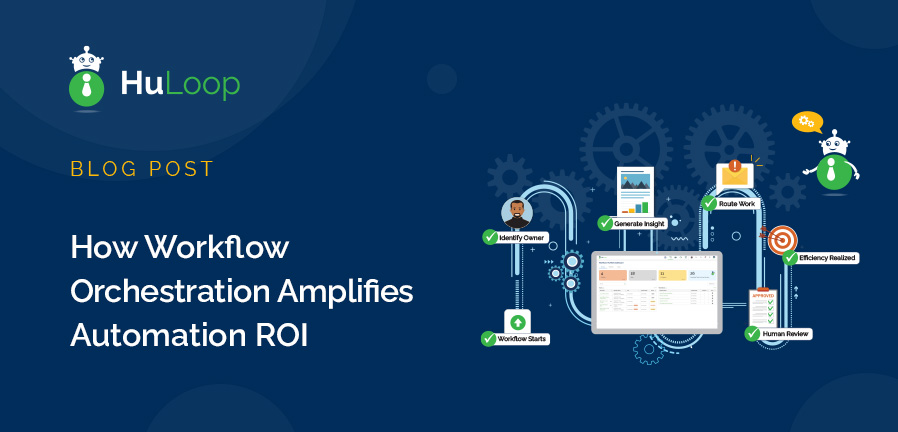
How Workflow Orchestration Amplifies Automation ROI
SHARE THIS:
By Todd P. Michaud, HuLoop CEO
When organizations set out to improve productivity, the discussion almost always begins with automation. Robotic process automation, AI-driven document processing and other technologies promise speed, scale and cost reduction. And when applied well, they absolutely deliver.
The problem isn’t automation.
The problem is expecting automation to fix work that isn’t well organized in the first place.
For many knowledge-work-heavy organizations, particularly those operating in regulated environments, the primary constraint on productivity is not the execution of tasks. It’s the lack of clarity around how work moves.
Who owns the next step? When does a handoff occur? What approvals are required, and in what order?
When these questions are answered informally, automation alone can’t deliver its full value. In fact, it often accelerates confusion rather than eliminating it.
This is where intelligent workflow orchestration creates value.
A Different Kind of Efficiency Lever
Intelligent workflow orchestration doesn’t compete with automation. It strengthens it.
Workflow orchestration focuses on repairing the flow of work rather than replacing people or eliminating tasks: defining ownership, sequencing decisions, managing handoffs and making progress visible. Automation focuses on executing tasks faster and more accurately. Together, they form a more complete operational system.
Organizations that deploy workflow orchestration on its own, without automating keystrokes or processing documents, routinely see productivity improvements in the range of 10-25%, along with cost savings of 8-20%.
These gains do not come from workforce reduction. They come from eliminating systemic inefficiencies that exist in almost every manual process: waiting, rework, ambiguity, and manual coordination.
In practical terms, workflow fixes broken work.
Structuring Human Work So Automation Can Succeed
At its core, intelligent workflow orchestration creates structure around work that is currently coordinated through email threads, shared inboxes, spreadsheets and institutional memory.
Workflow defines:
- Clear ownership for each task
- Required sequencing and decision paths
- Explicit approvals and exception handling
- Real-time visibility into work in progress
People continue to do the work they were hired to do. What disappears is the wasted effort spent determining how that work should move through the organization.
When automation is added on top of this structure, its impact increases dramatically. Automated steps occur at the right time, with the right inputs and without creating downstream bottlenecks.
Where the Gains Actually Come From
The largest source of improvement is the reduction of waiting time between steps. In many operational and back-office processes, as much as 30-50 % of total elapsed time consists of waiting rather than working.
Tasks sit idle while approvals are pending, handoffs are unclear, or someone simply has not noticed that action is required. Workflow orchestration makes work visible, routes it automatically, and enforces timing expectations.
The result is a meaningful reduction in cycle time, often in the range of 15-30%, which directly improves responsiveness without increasing headcount.
A second source of value comes from reducing rework. Informal processes allow incomplete submissions, unclear decision criteria, and inconsistent routing to propagate downstream.
Workflow orchestration enforces required inputs and standard paths while still allowing for defined exceptions. As a result, organizations see fewer back-and-forth clarifications and higher first-pass completion rates, typically reducing rework by 10-20%.
The third area of improvement is the elimination of manual coordination. In the absence of workflow, managers and supervisors spend a disproportionate amount of time checking status, sending reminders, chasing approvals, and maintaining tracking spreadsheets.
Workflow orchestration replaces this effort with automated task assignment, service-level timers, escalation rules, and real-time dashboards. This often translates into a 20-40% reduction in coordination time for leaders, allowing them to focus on coaching, risk management, and decision-making rather than traffic control.
Finally, workflow improves the utilization of existing staff by making work measurable and transparent. When leaders can see workloads, bottlenecks, and idle capacity in real time, they can rebalance work and respond to demand fluctuations more effectively.
This visibility typically produces an effective capacity gain of 5-15%, enabling the same team to handle more volume without additional hiring.
Financial Impact Before and After Automation
One of the most significant sources of savings is avoided headcount growth. As volumes increase, structured workflows allow teams to absorb additional demand without expanding staff. In practice, organizations often avoid one new hire for every 8-15 knowledge workers, resulting in annual savings of approximately $80,000 to $120,000 per avoided full-time equivalent.
Workflow also reduces overtime and reliance on temporary labor by minimizing last-minute escalations and fire drills. Clear ownership and sequencing reduce the need for after-hours work, commonly cutting overtime by 10-25%.
In regulated environments, workflow further reduces compliance and audit costs by providing built-in audit trails, time stamps, and approval evidence. This lowers the effort required to gather documentation and reduces the likelihood of audit findings tied to process inconsistency or missing approvals.
When automation is layered into this foundation, the financial impact compounds. Automated execution removes remaining manual effort, while workflow ensures that automation operates within a well-governed system.
Why Workflow Makes Automation More Valuable
Automation delivers its greatest returns when it operates within a clearly defined flow of work. Without that structure, organizations risk automating broken processes and scaling inefficiency.
Workflow orchestration typically requires less technical change, fewer integrations, and less security review. It can be deployed incrementally and begin improving human work immediately.
Many organizations see positive ROI within 60-90 days. Automation multiplies the value over time, but workflow establishes the foundation that makes those gain sustainable.
Another Weapon in the Arsenal
Operational improvement isn’t about choosing between workflow and automation. It’s about using the right tools together.
Process discovery helps identify where work is broken. Workflow orchestration fixes how work moves. Automation removes manual execution. Document processing reduces friction tied to unstructured information.
Workflow is the connective tissue that brings these capabilities together.
By treating intelligent workflow orchestration as a complement to automation, organizations gain a powerful advantage: faster returns, stronger governance and a system that supports both human work and intelligent execution.
About the Author: Todd P. Michaud
 As President and Chief Executive Officer, Todd P. Michaud leads HuLoop’s strategy and oversees its execution. He is an accomplished, results-oriented, and high-energy technology executive with a sustained track record for driving breakout growth and building enduring, software businesses. Whether launching successful startups, scaling growth phase companies, or turning-around mature software businesses, Michaud succeeds by building and leading high-performing, multi-cultural, and global teams. Before HuLoop, Michaud has held executive roles at DemandTec, Hypersonix, Symphony Retail, Amdocs, NCR Corporation, Retalix, Revionics, IDS LLC, and IBM Corporation.
About HuLoop Automation
Based in the Sacramento area, California, HuLoop Automation serves enterprises who are digitally transforming their businesses to maximize human productivity and improve customer experience, all while leveraging existing technology investments. HuLoop has built a unified work optimization platform to help enterprises automate manual, mundane tasks, so their human talent is able to spend time on higher value work. Our AI-based, codeless, Human-in-the-Loop software eliminates mind-numbing work, saving our clients money and improving employee satisfaction. Learn more at www.huloop.ai and follow HuLoop on LinkedIn, Facebook and X (formerly known as Twitter).
