



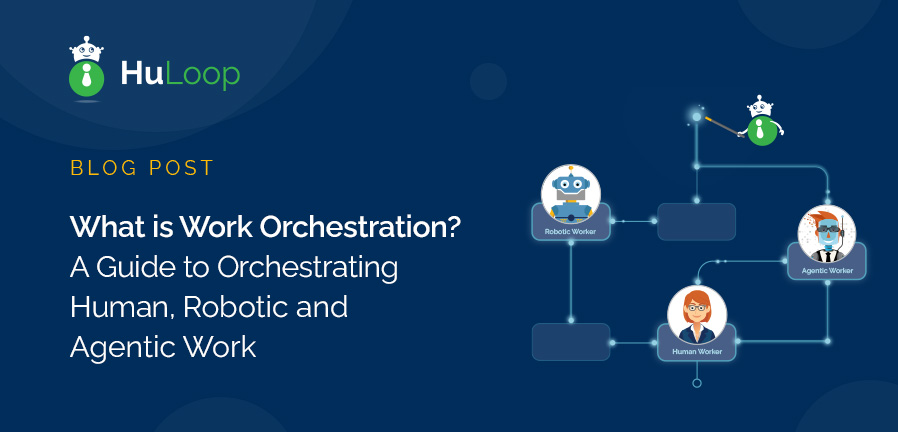
What is Work Orchestration? A Guide to Orchestrating Human, Robotic and Agentic Work
SHARE THIS:
Work is changing and most organizations aren’t keeping up. Organizations today face a growing challenge: they are expected to deliver more work, faster, with the same or fewer resources.
Employees are spread across dozens of applications. Processes span multiple departments. Customer expectations continue to rise. Yet much of the work that keeps businesses running remains fragmented, manual, and difficult to scale.
Many organizations attempt to solve this problem through workflow automation. While automation can eliminate repetitive tasks, it addresses only part of the challenge. Modern enterprises need a broader approach.
This is where Work Orchestration comes in.
Work Orchestration helps organizations coordinate human workers, robotic workers, and AI-powered agentic workers across systems, processes, and departments to ensure the right work is completed by the right worker at the right time. Rather than focusing solely on task automation, Work Orchestration optimizes how all work gets done across the enterprise.
What is Work Orchestration?
Work Orchestration is the practice of intelligently coordinating human workers, robotic workers, and AI-powered agentic workers to execute business processes efficiently, consistently, and at scale. It provides a unified framework for managing work across people, applications, systems, and automation technologies.
Instead of asking: “Can this task be automated?,” Work Orchestration asks: “Who or what is best suited to perform this work?”
The answer may be:
- A human worker
- A robotic worker
- An AI-powered agentic worker
- Or a combination of all three
The goal is not to replace people. The goal is to ensure every type of work is handled by the most effective resource available while keeping humans in control of critical decisions.
The Three Types of Workers in Work Orchestration
At the core of Work Orchestration is the idea that different types of work require different types of workers.
Human Workers
Human workers provide capabilities that technology cannot fully replicate. These include:
- Strategic thinking
- Creativity
- Empathy
- Relationship building
- Ethical judgment
- Exception handling
- Accountability
Humans are most valuable when solving problems, making decisions, and managing situations that require context and experience.
Robotic Workers
Robotic workers execute structured, rules-based tasks with speed and consistency. These workers excel at:
- Data entry
- Form processing
- System updates
- Report generation
- Transaction processing
- Repetitive administrative work
Robotic workers operate continuously, reduce human error, and scale instantly.
Agentic Workers
Agentic workers are AI-powered workers capable of pursuing goals rather than simply following predefined rules. Unlike traditional automation, agentic workers can:
- Analyze context
- Make recommendations
- Adapt to changing conditions
- Coordinate across systems
- Complete multi-step processes
- Support decision-making
Agentic workers are ideal for dynamic, knowledge-intensive work that requires reasoning and adaptability.
Why the Combination Matters
The highest-performing organizations do not choose between humans, automation, or AI. They build teams that combine the strengths of all three. Just as high-performing human teams bring together individuals with different skills and perspectives, the workforce of the future will unite human workers, robotic workers, and agentic workers into a single, coordinated team.
Each contributes unique capabilities. Human workers provide judgment, creativity, empathy, and oversight. Robotic workers execute repetitive, rules-based tasks with speed and consistency. Agentic workers analyze information, make recommendations, adapt to changing conditions, and coordinate complex workflows.
Individually, each worker type adds value. Together, they become more than the sum of their parts. When work is intentionally orchestrated across these complementary teammates, organizations create a more scalable, resilient, and efficient operating model than any one workforce could achieve alone.
Why Work Orchestration Matters
As organizations grow, work becomes increasingly distributed across departments, applications, and teams. Without orchestration, businesses often experience:
- Approval bottlenecks
- Process delays
- Duplicate work
- Data silos
- Limited visibility
- Rising operational costs
- Inconsistent customer experiences
- Difficulty scaling operations
Work Orchestration addresses these challenges by creating a coordinated system for managing work across the entire organization. The result is greater productivity, agility, and operational control.
Key Benefits of Work Orchestration
Increased Productivity
Many employees spend significant portions of their day on administrative work that adds little strategic value. Work Orchestration ensures repetitive tasks are handled by robotic workers while humans focus on higher-value activities. This allows organizations to increase output without increasing headcount.
Better Use of Human Talent
Employees are most effective when performing work that requires judgment, creativity, and collaboration. By removing low-value activities, organizations enable people to focus on the work that drives business outcomes.
Faster Process Execution
Work moves more quickly when tasks are automatically routed to the appropriate worker. Approvals, requests, escalations, and handoffs occur without unnecessary delays.
Reduced Errors and Improved Compliance
Automated execution reduces manual mistakes while standardized workflows improve consistency and governance. This helps organizations maintain compliance and reduce operational risk.
Greater Visibility
Work Orchestration platforms provide real-time insight into how work moves across the organization. Leaders can identify bottlenecks, monitor performance, and make data-driven decisions.
Improved Customer Experiences
When work is coordinated efficiently behind the scenes, customers benefit from:
- Faster responses
- More accurate information
- Consistent service delivery
- Improved issue resolution
The result is higher satisfaction and stronger customer loyalty.
How Work Orchestration Works
Work Orchestration combines automation, workflow management, AI, and operational intelligence into a single framework. Most orchestrated workflows follow a simple model:
Trigger
Work begins when an event occurs. Examples include:
- A customer request
- A support ticket
- A new employee hire
- A purchase request
- A sales opportunity
Evaluation
The platform determines:
- What work needs to be completed
- Which worker is best suited for each task
- Whether human approval is required
- What systems need to be involved
Orchestration
Tasks are assigned to the appropriate worker:
- Humans for judgment-based decisions
- Robotic workers for structured execution
- Agentic workers for adaptive and knowledge-driven tasks
Execution
Work is completed across systems, applications, and teams while maintaining visibility and accountability.
Optimization
Performance data is analyzed continuously to identify opportunities for improvement and greater efficiency.
Common Work Orchestration Use Cases
Work Orchestration is not limited to a single department or business function. Wherever work moves between people, systems, and decisions, orchestration can streamline execution by ensuring the right work reaches the right worker, whether human, robotic, or agentic, at the right time.
Below are just a few examples of how organizations are applying Work Orchestration across the enterprise.
Human Resources
Human Resources teams manage hundreds of interconnected processes throughout the employee lifecycle. Work Orchestration coordinates activities across HR professionals, AI agents, and business systems to create a more seamless employee experience.
Common use cases include:
- Employee onboarding and offboarding
- Benefits enrollment and administration
- Training assignments and certification tracking
- Performance review coordination
- New hire equipment and system provisioning
Rather than relying on emails and manual checklists, Work orchestration automatically coordinates each step, ensuring tasks are completed on time while giving HR teams full visibility into employee progress.
Sales
Sales organizations depend on speed, collaboration, and timely follow-up. Work orchestration helps ensure opportunities move efficiently from prospect to customer by coordinating activities across sales representatives, AI agents, CRM platforms, and marketing systems.
Typical use cases include:
- Lead qualification and scoring
- Opportunity routing
- CRM updates and data enrichment
- Sales forecasting
- Customer follow-up coordination
By reducing administrative work and automating routine handoffs, sales teams spend more time building relationships and closing business.
Customer Service
Exceptional customer experiences depend on resolving issues quickly and consistently. Work orchestration ensures every customer request is directed to the most appropriate resource while providing employees with the information they need to resolve issues efficiently.
Common applications include:
- Intelligent ticket triage
- Case routing and assignment
- Escalation management
- AI-powered knowledge retrieval
- Service-level agreement (SLA) monitoring
When human agents, AI assistants, and service platforms work together as one coordinated team, organizations can improve response times, increase first-contact resolution, and deliver more consistent customer experiences.
Finance
Finance departments oversee complex workflows that require both accuracy and compliance. Work orchestration automates routine processing while ensuring financial professionals remain involved in reviews, approvals, and strategic decision-making.
Examples include:
- Invoice processing
- Expense approvals
- Accounts payable workflows
- Compliance and policy reviews
- Financial reporting
The result is faster financial operations, stronger governance, and reduced manual effort across the accounting function.
Banking and Credit Unions
Financial institutions operate in highly regulated environments where work frequently crosses departments, systems, and compliance checkpoints. Work orchestration helps coordinate these activities while improving efficiency, visibility, and customer service.
Representative use cases include:
- Account opening and loan origination
- Know Your Customer (KYC) and Anti-Money Laundering (AML) reviews
- Regulatory reporting and audit preparation
- Dispute and exception handling
- Core banking system updates
By orchestrating work across bankers, AI agents, and banking technologies, financial institutions can accelerate service delivery while maintaining the governance and oversight required in a regulated industry.
Operations
Operations teams are responsible for keeping the business running efficiently. Work Orchestration improves coordination across departments, suppliers, applications, and intelligent systems, ensuring work progresses smoothly from initiation to completion.
Typical operational use cases include:
- Procurement workflows
- Vendor management
- Resource allocation
- Project coordination
- Quality assurance
As organizations grow, operational complexity increases. Work orchestration provides the visibility and coordination needed to reduce bottlenecks, improve collaboration, and scale operations more effectively.
Work Orchestration vs. Workflow Automation
Although the terms are often used together, they are not the same.
Workflow Automation
Workflow automation focuses on automating individual tasks and processes through predefined rules. Its primary objective is reducing manual work.
Work Orchestration
Work Orchestration focuses on coordinating all work across humans, robotic workers, and AI workers. Its objective is optimizing how work is performed across the enterprise. Workflow automation is a component of Work Orchestration. Work Orchestration is the broader operating model. Think about it this way: Workflow Automation automates tasks. Work Orchestration coordinates work.
Signs Your Organization Needs Work Orchestration
Your organization may benefit from Work Orchestration if you experience:
- Repetitive manual work
- Multiple disconnected systems
- Limited operational visibility
- Frequent process delays
- High administrative overhead
- Growing compliance requirements
- Difficulty scaling operations
- Employee burnout from low-value tasks
These challenges often indicate that work is fragmented and requires a more coordinated approach.
Choosing a Work Orchestration Platform
The right Work Orchestration platform should provide:
- Workflow automation capabilities
- Human-in-the-loop management
- Robotic process automation
- Agentic AI capabilities
- Process intelligence
- Analytics and reporting
- Enterprise integrations
- Governance and compliance controls
- Scalability across departments
The best platforms orchestrate work across existing systems rather than requiring organizations to replace the technology they already use.
The Future of Work Orchestration
The future of work is not purely human, purely robotic, or purely AI-driven. It is orchestrated. Organizations are increasingly deploying hybrid workforces that combine people, automation, and AI agents to achieve greater productivity and agility.
Future Work Orchestration platforms will continue to:
- Predict operational bottlenecks
- Recommend process improvements
- Coordinate AI agents autonomously
- Optimize resource allocation
- Deliver deeper operational intelligence
- Enable enterprise-wide scalability
As technology continues to evolve, Work Orchestration will become the foundation for how modern organizations operate.
How HuLoop Delivers Work Orchestration
HuLoop’s Work Optimization Platform brings the three worker types described above, human, robotic, and agentic, into a single environment built for regulated industries, such as banks and credit unions. Rather than asking your team to replace core systems, HuLoop orchestrates work across the applications you already use, while giving C-level executives the visibility, governance, and audit trail their examiners and boards expect. HuLoop is built for organizations below approximately $15 billion in revenue or assets under management, and is delivered both directly and through trusted implementation partners.
Conclusion
Work Orchestration represents the next evolution of operational excellence. While workflow automation focuses on automating individual tasks, Work Orchestration coordinates the entire workforce, including humans, robots, and AI agents to ensure work is completed efficiently, intelligently, and at scale.
Organizations that embrace Work Orchestration can eliminate low-value work, improve employee productivity, enhance customer experiences, and build operations capable of supporting long-term growth.
The question is no longer whether work should be automated. The question is whether every task is being performed by the worker best equipped to do it.
See how HuLoop’s Work Optimization Platform can orchestrate human, robotic, and agentic workers across your organization. Contact HuLoop to schedule a conversation.
